
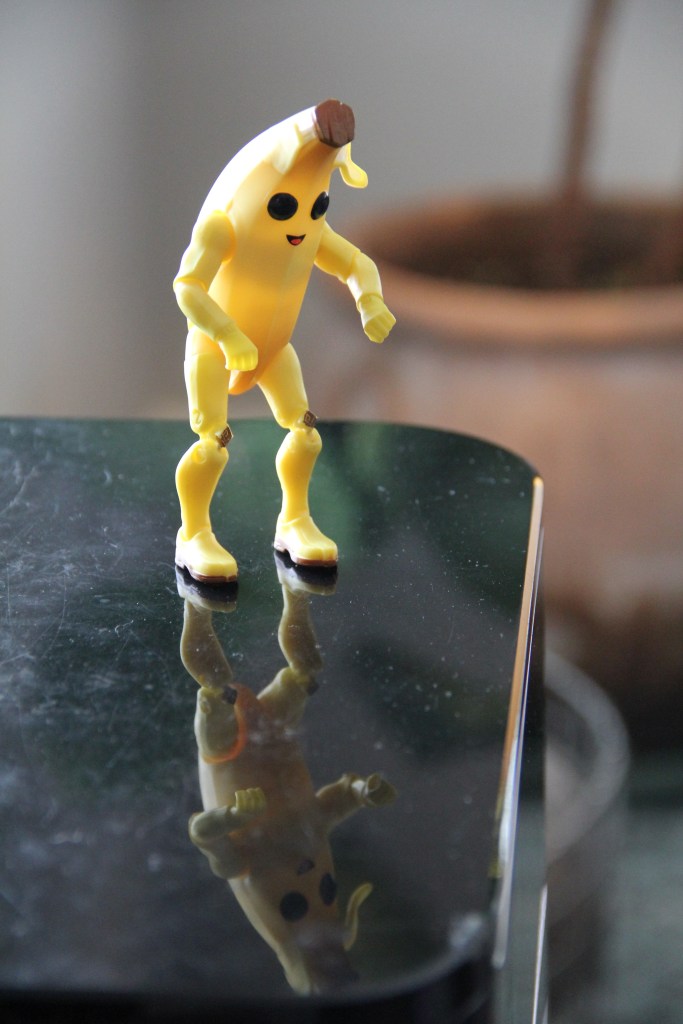
Staring at the cold, plastic reflection looking back at him, Dr. Peter Lee understood the reality that would define the rest of what remained of his now short life: “I’m a banana?!?”
These words did not come out the way most do, breathy, weightless, listless, and temporary. No! He regurgitated, rather than spoke them. They splattered toward the horrific yellow image in the mirrored surface upon which he stood. Involuntarily choking up from his fruity innards, they burned with acidic immediacy, were heavy with the weight of truth, reeked with fear and were ripe with disbelief and impending rot.
“A Banana!” He repeated, with a blast of doubt and grief billowing down from the ether through which reality often deals its most oppressive blows. “How is this even possible?”
Dr. Lee was a biochemist working in an inconspicuous research facility in Kendall, a relatively sleepy suburban community south of Miami. After spending nearly 4 years experimenting with 6-dimethylaminopurine and cycloheximide, two compounds proven to stimulate cloning in mammalian tissues, and a host of other extracts, compounds and organic material, he was certain he had finally stumbled on another revolutionary breakthrough.
Dr. Lee had garnered the attention of the scientific community when he pioneered the successful grafting of dopamine producing cells into the brain tissue of Monkey’s. The implications of this single discovery were staggering. It was thought, for example, that with this breakthrough, combined with the other body of research already composed, a long sought-after cure for Parkinson’s was imminent. Speculations ran wild about Dr. Lee’s findings and the popular media, competing for that ever elusive traffic to their websites, began presenting Dr. Lee, as the scientist who cracked the genetic code. In response, The financial backbone of stem-cell research labs around the world had unloaded their vaults in the direction of Dr. Lee’s breakthrough results.
For the next three years, He had enjoyed the fame and luxury that so often follows such notoriety. More recently, however, things had changed. Dr. Lee failed to bring the wild speculations back to reality, choosing instead to bask in the glory. So much so, he started to believe his own press. This was totally unfounded since other researchers were unable to duplicate the findings of increased dopamine production following the methods Lee outlined in his papers. People had not moved to dismissing his results entirely, but pressure was being placed on him to produce new results. In the mounting demands for additional progress, Dr. Lee had responded by experimenting with increasingly radical chemical combinations. Three years later, he had not produced any additional results. Doubts began to spread in the broader scientific community about his abilities as a biochemist.
Within his tight circle of loyal researchers, however, there remained a palpable excitement. They believed Dr. Lee would achieve the unthinkable – the creation of the “life spark,” the key to the fountain of youth. But as time wore on, that circle progressively decreased leaving Dr. Lee to fight through the most difficult aspects of his research with only the most loyal of his followers. It seemed that the swelling clouds of a ruinous hurricane were swirling around his feverish efforts. Skepticism, accusation and isolation were ever threatening to render his life’s work obsolete.
It was common practice to experiment with biochemical catalysts in the science of cloning and stem cell research, but Dr. Lee isolated himself from the status quo when he asserted that 1-octen-3-ol, a toxin in mold thought to contribute to Parkinson’s Disease, could be harnessed to reverse it’s affects. On this theory, he was wrong! Leading the the first of many investors and supporters to publicly withdraw their support.
After the media storm died down Dr. Lee was undaunted. He continued with his mold spore theory amid growing resistance. He had seen enough intriguing evidence in his combinations of these volatile biochemical compounds that he was convinced, even if others were not. He believed he was close, and there were enough people who still agreed, investors and researchers alike, that he was emboldened to go on.
That’s when it happened.
He discovered a rapidly mutating RNA strand in the fungus (fusarium oxysporum forma specialis cubense – or just fusarium for short) that caused Panama Disease – a devastating infection sometimes found in the banana groves south of his lab in sunny south Florida capable of destroying entire crops in a matter of days.
The irony was not lost on Dr. Lee, or his close associates, that as a leading stemcell researcher, Dr. Lee was now pinning his hopes on experiments involving cells from the stems of infected bananas. One particularly sarcastic young researcher even noted that Dr. P. Lee, written on the nameplate on the corner desk, might be better written as “Dr. Peely” – it was not intended as a compliment.
Even though most of those remaining now were his closest and most loyal associates, the pressure of dwindling funds, and the exodus of once loyal believers had left Dr. Lee paranoid and frantic. That’s how he found himself alone in the laboratory long after he had sent everyone else home.
He sat in a swivel chair beside a table covered with beakers and tubes filled with bubbling liquids. He had his lab coat sleeve rolled up and a band wrapped around his forearm. His fingers, already tinged with blue from the taught band, clutched a syringe filled with a milky-yellowish liquid.
He was staring off into his dimly lit lab at nothing in particular and everything all at once.
To be continued…
 johnallenbishop